Library
Books . References . Research
Crash Mail
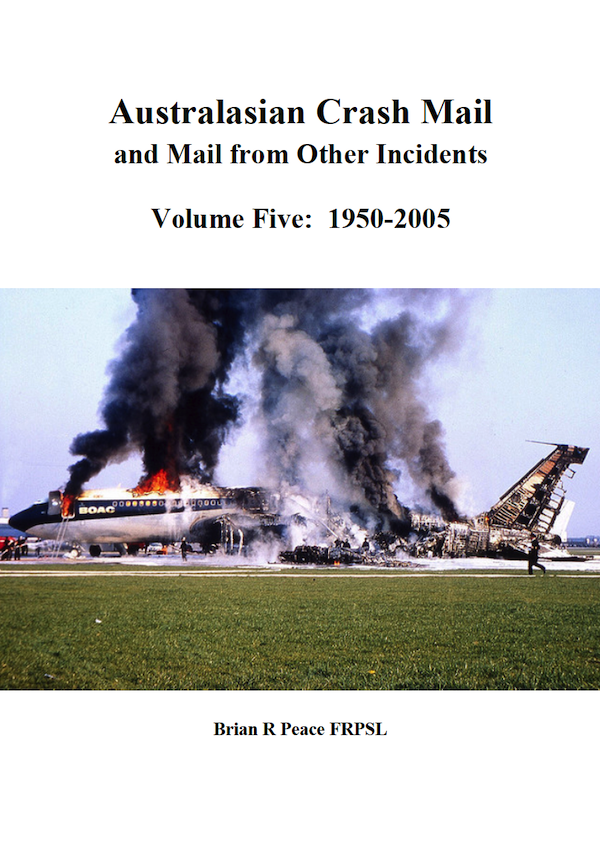
Australasian Crash Mail and Mail from other Incidents, Volume Five : 1950 - 2005
Brian R. Peace FRPSL APR
© 2023
At 285 + xiv pages, the book is the culmination of decades of research and writings. The author first wrote on the subject 50 years ago, and is the acknowledged authority on the subject. It may be that the readership will turn out to be wider than auctioneers, aero-philatelists and dealers.
POST PAID price is £50 in the UK, €65 to Europe, AU$140 to Australia. NZ$160 to New Zealand, US$100 to the USA & CA$120 to Canada Payment online in GB£ to account of B. R. Peace, Sort 05-00-40 Account 10082204, or in AU$ to BSB 063000 Account 12391146 or by PayPal to brpeace@ntlworld.com adding 4 per cent.
This hard cover, 300 page book covers all crashes and incidents with an Australian, New Zealand or Papua New Guinea connection where mail was involved; but it is much more than that. The author has been thorough in setting a context; not simply explaining the distinction between an accident and an incident.
The book is effectively a comprehensive demonstration of the challenges and hazards facing pilots and the growing airline industry in the post war years, from a social and historical, as well as a philatelic, perspective.
The tables at the end of each of the first four chapters are useful in that it is a relatively simple task to check air mail covers to establish if they could have been involved in an accident or incident.
The inclusion in tables of the amount of mail carried, and the recorded or estimated numbers of surviving covers, will be invaluable for auction houses and dealers as well as collectors. Whilst some would prefer to see values, auction realisations or scarcity ratings included, the author has deliberately avoided their inclusion.
A detailed census has been prepared for all accidents where more than 4 examples are recorded. It must be stressed that each of these is a preliminary census and must be treated as a work in progress. Where 4 or fewer examples are recorded, they are described and illustrated in the text.
Chapter 2 - New Zealand internal airmails - is larger than in previous volumes. Chapter Three also includes many flights to and from New Zealand including the 1979 Air New Zealand crash on Mount Erebus in Antarctica.
Chapter 4 covers two hijacks of aircraft carrying mail to Australasia.
Chapters 5, 7 and 8 include updated censuses from previous volumes.
The extensive list of references points to this study being not only thorough, but wide-ranging. The possibility of new crash covers emerging is an incentive for aero-philatelists, and dealers, to re-examine their air mail covers from this period.
The book has been well researched and will be essential to anyone interested in airmail of Australia, New Zealand or Papua New Guinea.
Volumes 1, 2 and 3 are sold out but will be reprinted, with updates, when ten orders for a volume are received.
Note: Volume Three of the series covering 1936-1939 (2021) was awarded Large Gold at the New Zealand National Philatelic Literature Exhibition in November 2021. It also received Felicitations for Research, Best Monograph and Grand Award.
Reviewed by Ken Sanford
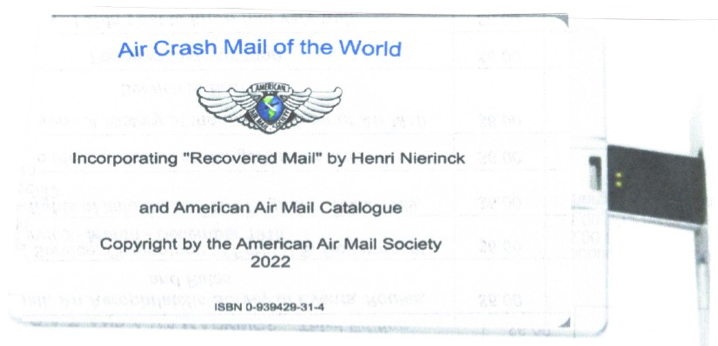
Air Crash Mail of the World
Ken Sanford
© 2023
Order from: Ken Sanford, 613 Championship Dr., Oxford, CT – USA 06478-3128. Make checks payable to American Air Mail Society, or PayPal to kaerophil@gmail.com and add $1.70.
Price:
To USA - US$32.00
To all other countries – US$34.00 (postage included)
A complete revision and update of “Recovered Mail” by Henri Nierinck, and the American Air Mail Catalogue, Sixth Edition, Vol. 1, Interrupted Flights section.
Covers all known air crashes from which mail has been recovered and is recorded in collectors’ hands.
Over 2,000 pages and 1600 illustrations of cachets, labels, post office memos, and crash markings, many in full color.
Pricing has been brought up to date, to reflect the current market.
Available on a flash drive.
Reviewed by Ken Sanford
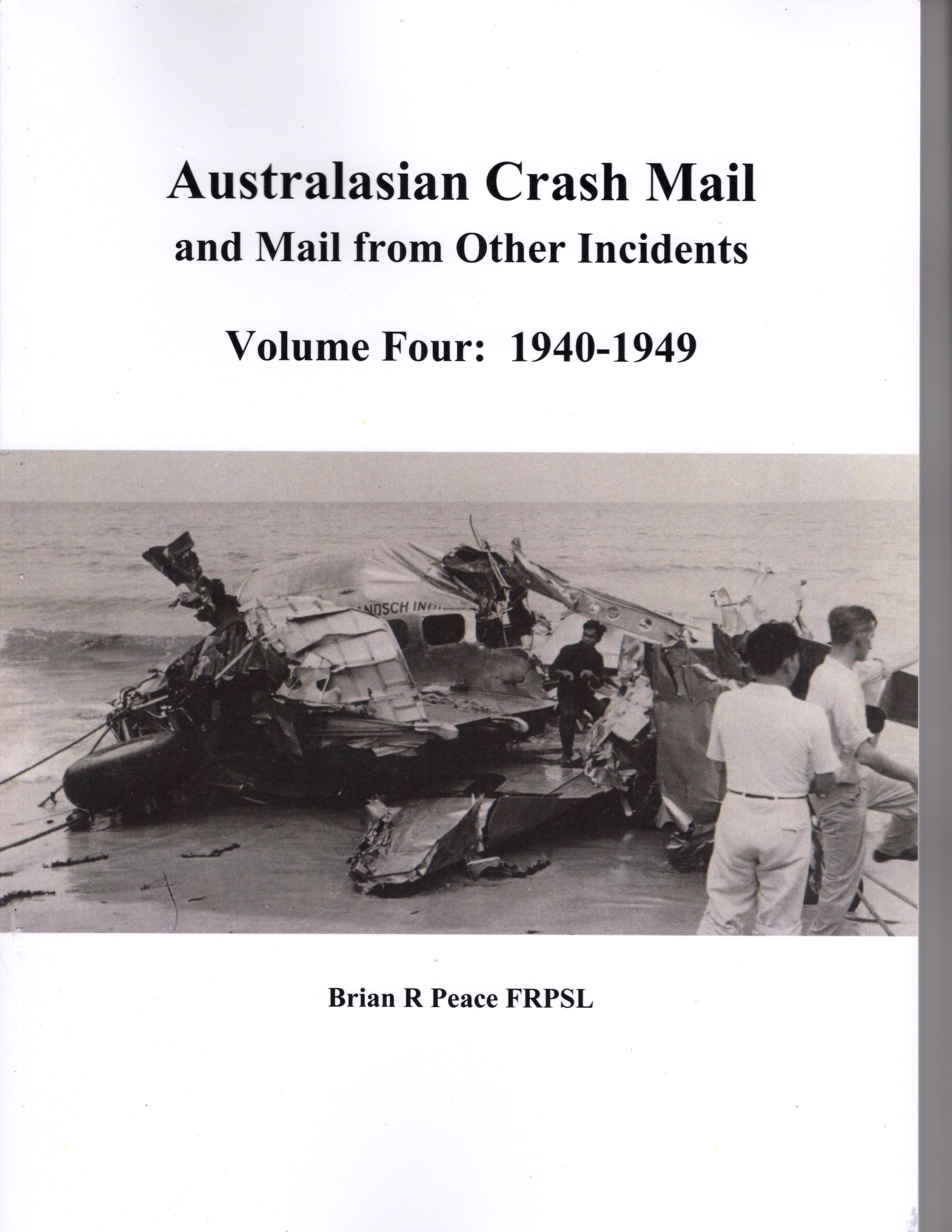
Australasian Crash Mail and Mail from other Incidents, Volume Four : 1940-1949
Brian R. Peace, FRPSL
© 2022
At 200+ pages the book is the culmination of decades of research and writings. All of the cover images are in color. The author first wrote on the subject 50 years ago, and is the acknowledged authority on the subject. It may be that the readership will turn out to be wider than auctioneers, aerophilatelists and dealers.
Postpaid price is £35 in the UK, EUR45 to Europe, US$70 to the USA and AU$100 to Australia. Payment online in GBP to B R Peace Sort 05-00-40 Account 10082204, or in AUD to BSB 063000 Account 12391146 or by Paypal to brpeace@ntlworld.com, adding 4 per cent
This is the 4th book in the series on Australasian crash mail. This book covers all crashes and incidents where mail was involved; but it is much more than that. The author has been thorough in setting a context; not simply explaining the distinction between an accident and an incident.
The book is effectively a comprehensive demonstration of the challenges and hazards facing air forces, pilots and the growing airline industry, from a social and historical, as well as a philatelic, perspective. The tables at the end of each of the first four chapters are useful in that it is a relatively simple task to check air mail covers to establish if they could have been involved in an accident or incident.
The inclusion in tables of the amount of mail carried, and the recorded or estimated numbers of surviving covers, will be invaluable for auction houses and dealers as well as collectors. Whilst some would prefer to see values, auction realisations or scarcity ratings included, the author has deliberately avoided their inclusion. A detailed census has been prepared for all accidents where more than 5 examples are recorded. It must be stressed that each of these is a preliminary census and must be treated as a work in progress. Where 5 or fewer examples are recorded, they are described and illustrated in the text.
The author estimates that at least 20% more covers have survived than are listed in censuses. For example, in the case of 400122, over 50 covers are recorded in the census, yet it is likely that more than 60 probably exist. One of the main reasons for this disparity is that, until fairly recently, images of covers from crashes were not always included in auction catalogues.
Chapter Two on New Zealand internal airmails is larger than in previous volumes. Chapter Three includes much of the Pacific theatre during World War II. Research into wartime incidents has been challenging and the attribution of damaged covers to incidents, and the allocation of specific aircraft to incidents where mail was lost or damaged has not always been possible.
The extensive list of references points to this study being not only thorough, but wide-ranging. There are several serious incidents involving mail-carrying aircraft in Australia and the Pacific which have remained unrecorded in philatelic literature. The possibility of new crash covers emerging is an incentive for aerophilatelists, and dealers, to re-examine their air mail covers from this period.
Reviewed by Ken Sanford