Library
Books . References . Research
History
A New Perspective on Airmail Operations during the Siege of Przemyśl - (1914-1915)
Dr. Jerzy W. Kupiec-Weglinski, FRPSL
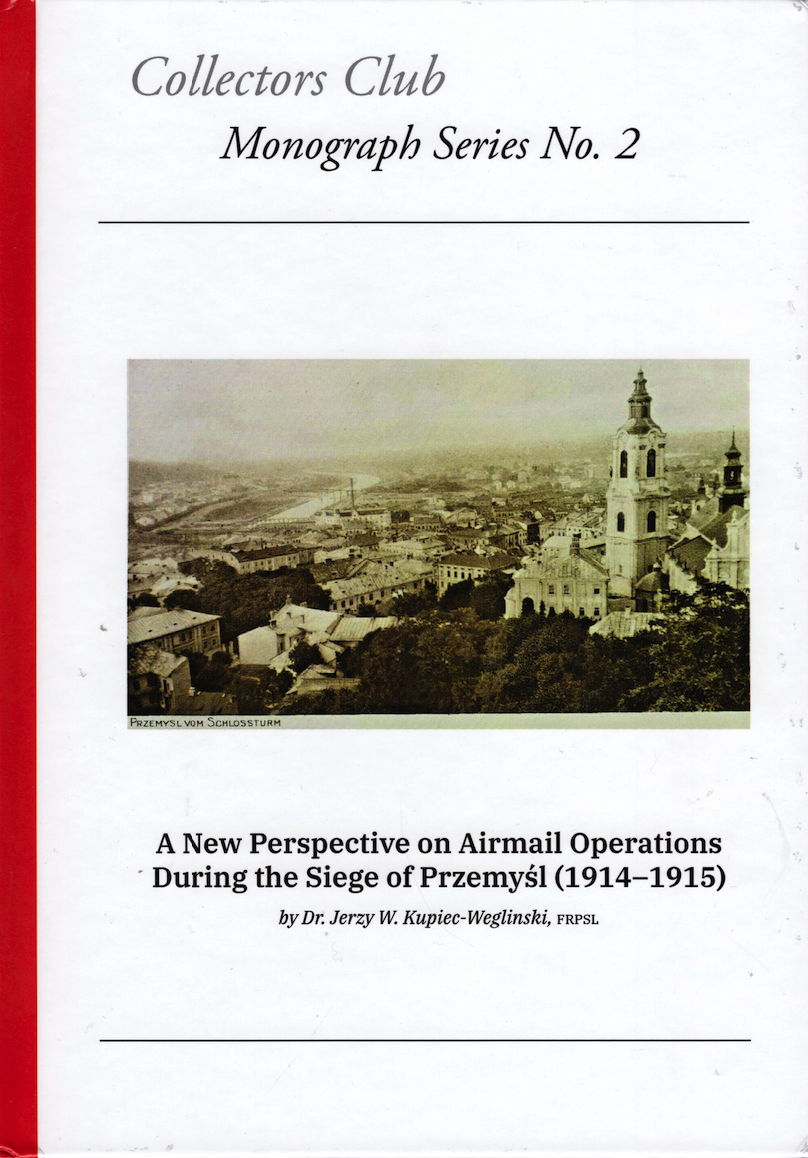
Second in a series of Monographs published by The Collectors Club, 11W 42nd St, New York, NY 10036-8008.
$25 plus $5 postage (media mail) within the US.
Inquire for postage cost outside the US. collectorsclub@collectorsclub.org
Initially published as a supplement to The Collectors Club Philatelist, May/June 2025, vol. 104, No. 3.
ISBN 978-0-9975119-2-5
Hardbound (7”x10" format);
88 pages, 97 illustrations, 2 tables, 4 appendices
BOOK REVIEW, by Ken Sanford
This monograph offers a fresh viewpoint on the postal history of one of the most devastating sieges in modern military history, when the town of Przemyśl in the Polish province of Galicia in the Austro-Hungarian Empire was besieged by the Russian Army during the winter of 1914-1915. Establishing a provisional airmail service by the Austrian Air Force in Przemyśl marked a historic moment, as it was the first time civilian mail-laden airplanes took off and landed in a besieged fortress. This initiative was not motivated by philatelic interests but was crucial for maintaining communication between the defenders and the outside world. These events unfolded in a remote region of Eastern Europe during the early stages of World War I, shortly after the launch of the world’s first airmail service in Allahabad, India, in 1911. Although the philatelic community recognizes the significance of the Przemyśl Siege mail, it has not achieved the same prominence as the Siege of Paris (1870-1871). Nonetheless, it constitutes an essential component of aerophilately, offering ample research opportunities for postal historians and shedding light on the operation of the world’s first humanitarian airmail bridge, while preserving human stories captured in vintage cards and covers for over a century.
Keith Tranmer (1928-2018), a prominent British authority on the Przemyśl Siege, wrote: “There are many interpretations of what constitutes postal history but in my long experience that human aspect that the student can discover is the true reward of collecting, and in a subject such as the siege of Przemyśl, which has a defined beginning and end, the collector is able to relate closely to some of the personalities engaged.” This monograph explores a group of individuals I have come to "know" through their messages on flimsy cards sent by air from the besieged fortress over a century ago. I trust the senders and recipients do not mind my intrusion into their private exchanges as I seek to shed light on the intricacies of wartime postal operations. The philatelic aspects offer a glimpse into the unique circumstances that reflect the challenging conditions under which these messages were crafted. These fragile, aged cards often tell remarkable stories of human resilience.
The Przemyśl Siege during the early stages of the Great War highlights the operational effectiveness of the Imperial and Royal Air Force, as well as the military and civilian Feldpost services. Although it was a brief and irregular operation, "Fliegerpost Przemyśl" symbolized resilience and facilitated family communication. Additionally, it was used to bolster troops' morale for war propaganda purposes. Ultimately, "Fliegerpost Przemyśl" was instrumental in establishing the world's first regular and international civilian airmail service, also Austro-Hungarian, along the Vienna - Kraków - Lwów - Kyiv route by the conclusion of World War I in 1918.
Many different cards and balloon mail covers are shown in color. There is an extensive bibliography, and 4 appendices showing forerunner air cachets on unofficial mail, airmail cachets & camouflage markings on official mail, official censor marks on flown mail & cachets on paper balloon flown mail from Przemysl. This is an excellent book on a little known aspect of aerophilately.
Der Zentralflughafen Berlin-Tempelhof im Zweiten Weltkrieg
Hans-Ulrich Schultz
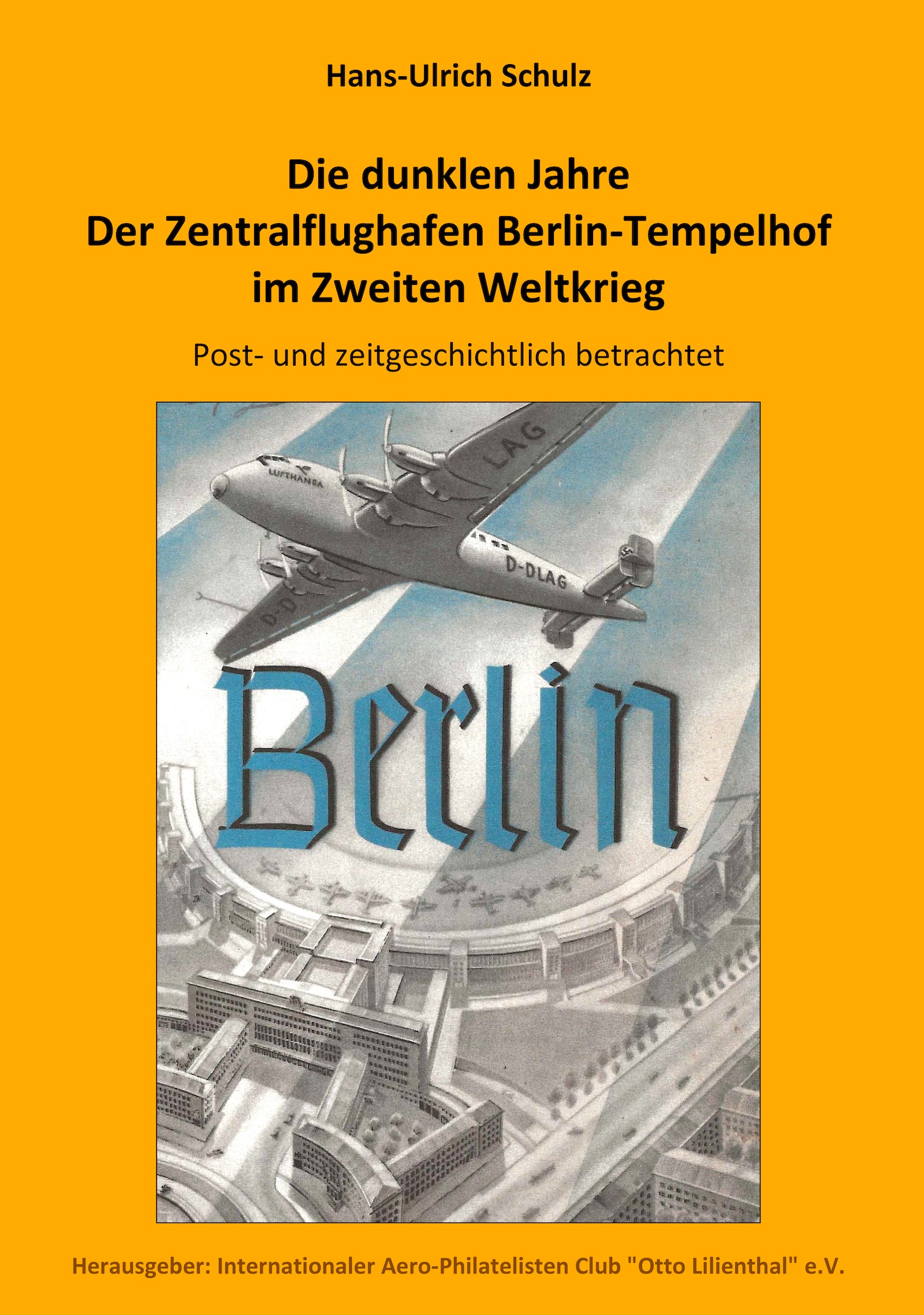
Impressum Internationaler Aero-Philatelisten Club "Otto Lilienthal e.V.
© 2024
Pages: 188
Photos: 200
Order: Hans-Ulrich Schultz, Machonsstrasse 47, D-12105 Berlin, Germany
The book details the flights of the Graf Zeppelin LZ-127 airship to and from South America using the flight covers contained in the authors philatelic exhibit of the same name. The book allows additional information to be added that exhibit space does not allow.
The major purpose and intent of the book is to preserve the details of the exhibit and in particular the postage rates associated with the flights illustrated.
The book also details the history of this airship, which was the most successful of its time, flying for nine years without fatality or significant issues.
The book shows the Exhibit Title Page and then has five sections, as follows:
Section 1 – 1930 & 1931 Pre-commercial South America flights
Section 2 – 1932 Launch of commercial scheduled flights to South America
Section 3 – 1933 Commercial flights, including Century of Progress flight
Section 4 – 1934 Commercial flights, including only flight to Argentina
Section 5 – 1935 to 1937 DLH aircraft support services
There are three appendices.
Appendix 1: 1929 Mail posted on board Graf Zeppelin airship
Appendix 2: Awards achieved by exhibits
Appendix 3: Index by country
All exhibit pages are shown in full color. The book is hard cover, A4 size.
The book is an excellent presentation of this award winning exhibit. It will be an excellent reference for collectors of Zeppelin mail to South America.
Reviewed by Ken Sanford
Les Légendes de l' Air & de l' Espace par l' Image et l' Autographe
Yves Saint-Ives & Michaël Lopez Saint-Ives
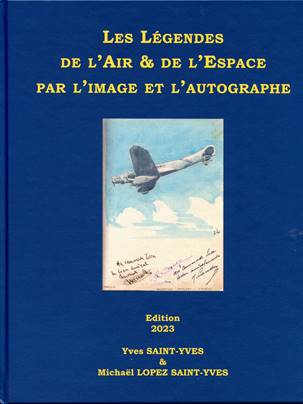
© 2023
Vous pouvez acquérir ce luxueux ouvrage de 300 pages au prix de 60 euros (franco de port pour les membres du CAF). Vous trouverez en pièce jointe le bon de commande, qui vous permettra également de commander, si vous le souhaitez, les 5 autres ouvrages publiés par Yves Saint-Yves depuis 2009.
Reviewed by Dominique Petit
Notre ami Yves Saint-Yves et son petit-fils, tous deux membres du CAF et passionnés de l’histoire aéronautique et spatiale, viennent de publier un nouvel ouvrage intitulé : Les légendes de l’Air et de l’Espace par l’image et l’autographe.
De Sophie Adenot (seconde femme sélectionnée par l’Agence Spatiale Européenne, après Claudie Haigneré) à Jan Zumbach (as polonais de la Seconde Guerre mondiale) en passant par Ader, Assolant, Bellonte, Breguet, Costes, Dagnaux, Daurat, Dewoitine, Fonck, Glenn, Guillaumet, Hilsz, Latécoère, Lindbergh, Mermoz, Pégoud, Vachet, les frères Wright, etc… , cet ouvrage propose les biographies de 166 femmes et hommes, disparus ou vivants, qui ont marqué l’histoire de la conquête de l’Air et le l’Espace.
Ces biographies sont illustrées de nombreux plis aérophilatéliques, photos et documents rares signés, souvent inédits, issus des collections personnelles des auteurs.
The History of Airmail in Poland and Its Contribution to Airmail Services of Europe (1914-1939)
Dr. Jerzy W. Kupiec-Weglinski
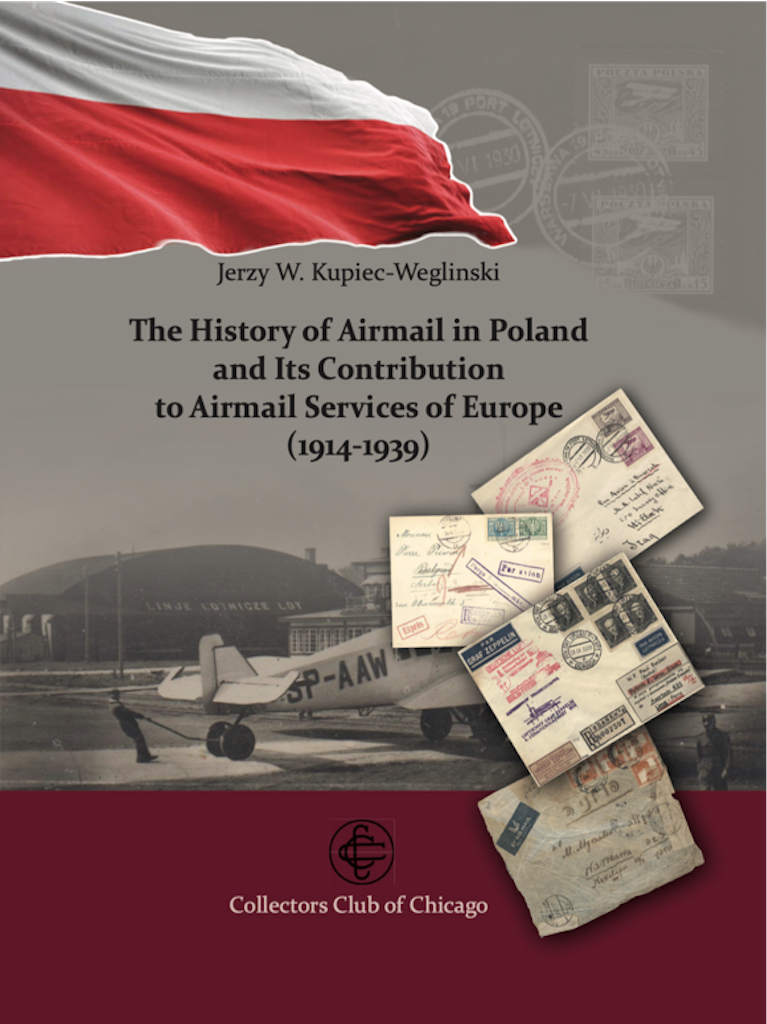
Published by the Collectors Club of Chicago
© 2021
The handbook is hardbound in an 8½”x11" format (21.5 x 28 cm) and includes 385 pages containing over 700 color illustrations.
The book is available in Europe for €65 plus s/h, with PayPal accepted for payment, to: jkupiec@mednet.ucla.edu.
It is available in the USA for $70.50 plus the following postage: $8.00 within the USA, Europe $15.00 (shipping from Poland) & to Canada $28.50 priority mail. Inquire about shipping cost to other countries.
See the Collector’s Club of Chicago website for details. (https://www.collectorsclubchicago.org/product/the-history-of-airmail-in-poland/).
Reviewed by Ken Sanford
This English edition is accompanied by Synopsis and Table of Contents in Polish and German.
The monograph, prefaced by Oxford-based Nobel Prize nominated historian Norman Davies, focuses on the development and operations of airmail services on the Polish territories throughout 25 years of turbulent European history during the 20th century. It begins with events originating in WWI in a remote area of the former Austro-Hungarian Empire's Galicia Province. It concludes with the German invasion of Poland in September 1939 and the outbreak of WWII. It is an in-depth encyclopedic history of the development of air post services not only in Poland but also in all of Europe and beyond.
The substantive material is presented in twelve chapters. The first chapter highlights the 1914-1915 airmail effort by Austrian Army from the besieged by Russian forces city of Przemyśl. The following chapter includes comprehensive descriptions and illustrations of the airmail postal route in 1918 from Vienna to Kyiv via Krakow and Lviv. Further chapters detail the development of domestic airmail operations, as well as joint services by Polish and foreign carriers to other countries and continents, air rallies, crash (interrupted) mail, and the Zeppelin mail from mainland Poland and the Free City of Danzig to the Americas. There are many tables and appendices which provide useful information about cancellations, cachets, miscellaneous postal marking, quantities of airmail carried between various cities, airmail labels used on the covers, a survey of Graf Zeppelin dispatches from Poland to South America, and much more.
The book is well researched and contains a wealth of information about early Polish & European airmail and will be essential for aerophilatelists interested in that area of aerophilately.
Deley et Vachet, Piliers de la Ligne
Bernard Bacquié
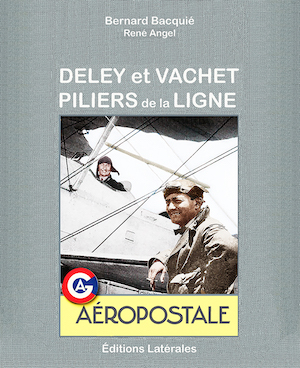
Ouvrage disponible au prix de 30 euros + 4 euros de participation aux frais d’envoi :
sur le site www.editionslaterales.com
via Paypal ou carte bancaire
par chèque à l’adresse :
Bernard Bacquié,
ÉDITIONS LATÉRALES
24 clos de la LLANURA, B-33
31130 BALMA
Avec cet ouvrage, Bernard Bacquié clôt définitivement sa série de beaux livres sur les Lignes aériennes Latécoère – Aéropostale. En point final, grâce à la participation de René Angel, il offre une gerbe de documents iconographiques inédits, minutieusement restaurés et colorisés, ainsi que des pans inconnus de cette épopée. On y découvre les rôles éminents qu’ont tenus ces deux pionniers : extension de la Ligne de Casablanca vers Dakar en ce qui concerne Deley, ouverture de la liaison par hydravions entre Alicante et l’Algérie pour Vachet ; et la création de la Ligne en Amérique du Sud à laquelle ils participèrent tous deux.
À partir de 1933, pour renforcer son réseau, Air France profita de l’expérience de Pierre Deley et de Paul Vachet, appréciés pour leur sens du commandement et de l’organisation, et membres de la phalange des pionniers qui pouvaient se compter sur les doigts d’une main. À ce titre, l’ouvrage fait le lien avec l »histoire d’Air France.
S’inscrivant dans la série des beaux livres des EDITIONS LATÉRALES, incluant trois ouvrages sur Saint-Exupéry, un sur Mermoz, un sur Guillaumet et celui sur Dieudonné Costes, le présent ouvrage, disponible depuis ce jour, 18 mai 2020, offre une complète narration de l’histoire des Lignes aériennes Latécoère et de l’Aéropostale à travers les carrières de Pierre Deley et de Paul Vachet, et cela par des illustrations inédites et un texte truffé d’anecdotes inconnues.
Il est étonnant de découvrir que si Mermoz avait défriché la traversée commerciale de l’Atlantique Sud, avait cherché des passages dans les Andes, il n’était pas de ceux qui, bien avant lui, avaient défriché les sables en ouvrant la ligne Casablanca - Dakar, de ceux qui avaient créé l’hydraviation commerciale entre Alicante et l’Algérie, de ceux qui avaient défriché les terrains d’Amérique du Sud. Parmi ces tout premiers pionniers, deux hommes se détachent nettement : Pierre Deley et Paul Vachet. Les figures de Robert Collet, d’Émile Lécrivain et de Marcel Reine sont également largement évoquées, ainsi que celle de Louis Mingat pour la partie des pionniers des hydravions.
L’aviation commerciale à l’Aéroport de Bordeaux-Mérignac
Jean-François Labrousse
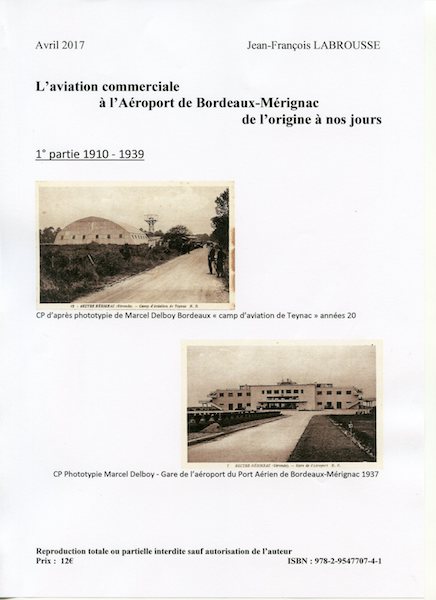
- © 2017
This booklet of 42 pages tells the history of this airport and is available from the author for 10 euro + P&P for members of CAF, others 12 euro + P&P.
L’aviation commerciale à l’Aéroport de Bordeaux-Mérignac de l’origine à nos jours
Jean-François LABROUSSE, 709 Avenue de la Bécasse, F-40150 Soorts-Hossegor labroussejf@orange.fr - Téléphone +33 (0)5 58 43 51 87 Consultez le site de Jean-François LABROUSSE
Caravelle S.E. 210
Jean-François Labrousse

- © 2017
Ouvrage de 78 pages dont 27 planches couleurs et 5 noir et blanc de cartes postales, photos, et surtout plis aérophilatéliques. Commande et renseignements auprès de Jean-François LABROUSSE : 709 Avenue de la Bécasse, 40150 Soorts-Hossegor, labroussejf@orange.fr , +33 (0)5 58 43 51 87 Consultez le site de Jean-François LABROUSSE : http:// www.airfrance-jflabrousse.fr/
Caravelle S.E. 210 - Premier avion commercial français à réaction Notre ami et collègue du CAF Jean-François Labrousse, présente son dernier ouvrage : CARAVELLE S.E.210 Premier avion commercial français à réaction
Ce répertoire (prix 18 € + port ) retrace l’histoire de l’utilisation de Caravelle par Air France. Annexes sur les autres compagnies ayant utilisé la Caravelle France et Etranger avec immatriculations, sur les versions de Caravelle et les immatriculations Air France. Tous les accidents sont aussi répertoriés.