Library
Books . References . Research
Spaceflight
Die Geschichte der Astronautischen Raumfahrt
Dr. Stephen Lachhein
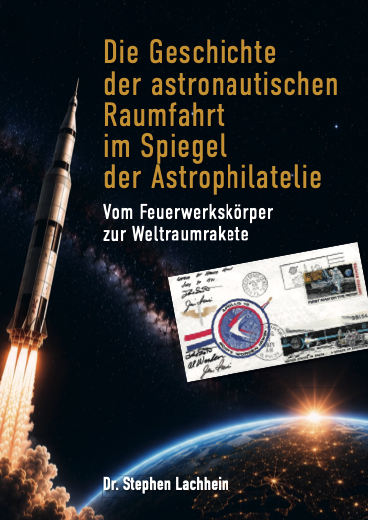
Published in 2026 by Dr. Stephen Lachhein
Hardcover book, A4 format
Impressive content of 262 pages
Glossy paper
380 images in colour
Contact Stephen Lachhein.
This beautiful book tells the story of spaceflight, from the early beginning over the major events (and accidents) in manned spaceflight, manned moonflights to manned space stations and modern spaceflight, ending with Artemis II.
- Author’s Foreword
- Early developments in rocketry: how it all began
- Peenemünde – V2: Von Braun’s work under the Nazis
- The Sputnik shock: the first rockets and satellites
- The first humans in Earth orbit, the race to the Moon
- The race to the Moon (USA and the Soviet Union
- The US Apollo Moon Programme
- Space stations (US/Soviet Union) and the Space Shuttle
- The development of manned spaceflight in China
- Open Philately
- Vorwort des Autors
- Frühe Entwicklungen von Raketen : wie fing denn alles an
- Peenemünde - V2: Wirken von Von Braun unter den Nazis
- Der Sputnik Schock : erste Raketen und Satelliten
- Erste Menschen im Erdorbit, der Wettlauf zum Mond
- Der Wettlauf zum Mond (USA und Sowjetunion
- Das Apollo Mondprogramm der USA
- Die Orbitalstationen (USA/Sowjetunion) und Shuttle
- Entwicklung der astronautischen Raumfahrt in China
- Open Philatelie
The Race to the Moon
Umberto Cavallaro

This handsome book reads like a novel and brings several seldom know facts about this Race to the Moon, especially marked on gray print in the book. The book measures 17x24 cm and has pictures of stamps, covers, postcards and oter material on this mission, divided over 340 pages.
The book is published and sold by Springer Verlag.
It is the Story of Puffery vs. the Pragmatic in the race to the Moon between the United States and Russia in the sixties of past century. The book covers the story from the first triggers from Sputnik over the Man in Space for both countries, to the changed directions in the space race. When the astronaut sits in the driver's seat, technological developments are big, until two tragedies block the race in space. The final leap is of course the landing of two astronauts on the Moon and safely returning home. The last chapter talks about the philatelic side of Apollo 11 and the Insurance Covers.
The preface is by Walter Cunningham, Apollo 7 astronaut.
Pioneer Rocket Mail & Space Mail
Walter Hopferwieser
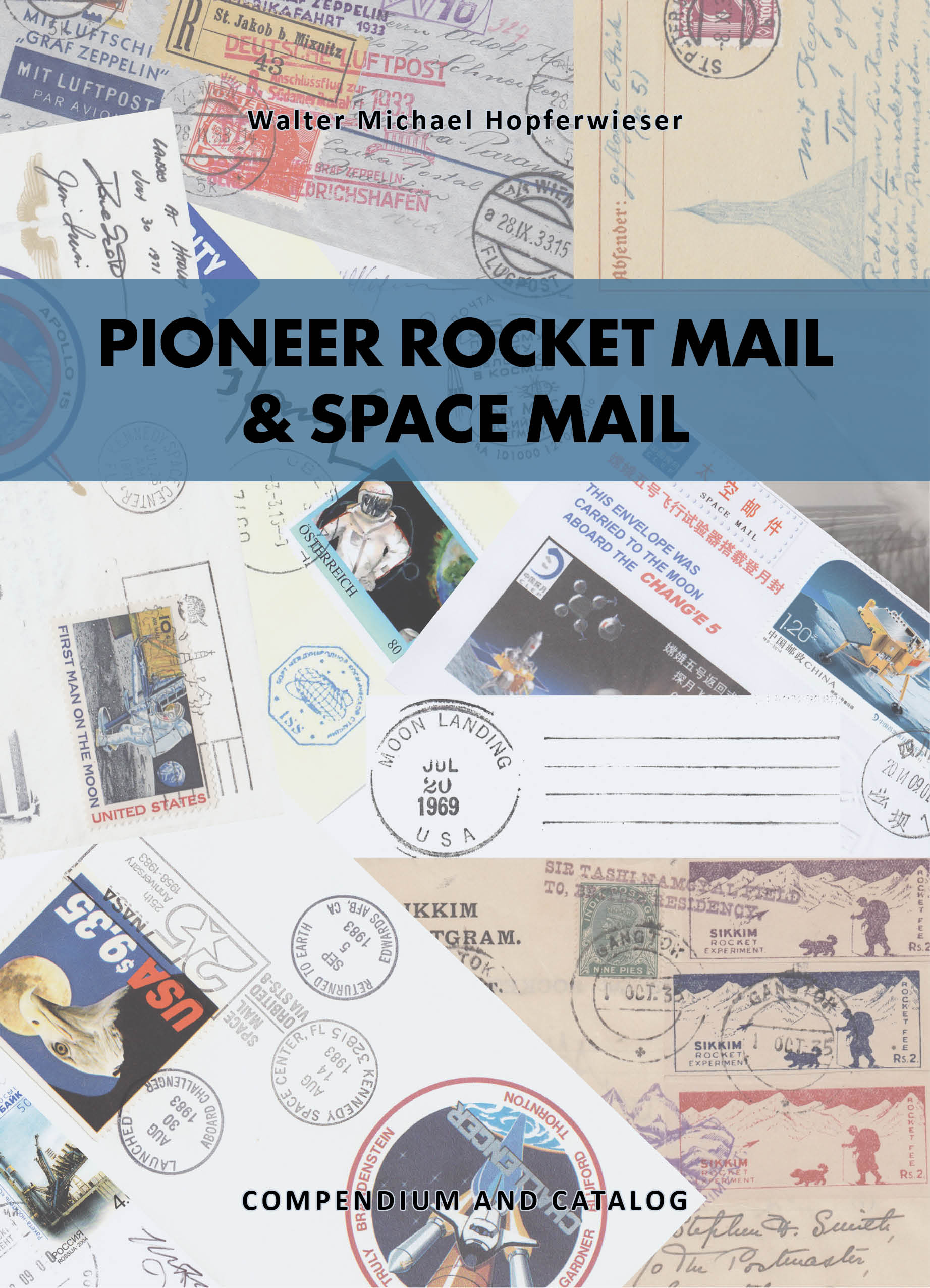
Walter Hopferwieser: "Pioneer Rocket Mail and Space Mail", 544 pages, hardcover with glossy foil.
It was translated by Annika Backe-Dahmen.
Published in own publishing.
ISBN: 978-3-9500207-1-7
Sales price: 49 €.
To be ordered from:
Walter Hopferwieser
walterhopferwieser@gmail.com
Just in time for the 50th anniversary of the first manned Moon landing Apollo 11, the compendium and catalog “Pioneer Rocket Mail and Space Mail” was published in English. It replaces the Ellington-Zwisler catalog, which was a must to have for the serious rocket mail collector for the past 50 years. Rocket launches including technical, historical, biographical and philatelic backgrounds are described in detail and are easy to understand. The collector value of the flown covers and rocket vignettes are shown in this book as well.
Between the two world wars, Austrian rocket mail pioneer Friedrich Schmiedl performed many rocket experiments which are described in this book. Schmiedl shot numerous rockets containing mail from a local mountain of Graz Schöckl down into the valley. This rocket pioneer wanted not only to accelerate the postal service, but also to begin space travel. In 1928, he fired a rocket from a stratospheric balloon and 5 years later he launched a high-altitude balloon from a rocket. In 1931, he launched a rocket from Schöckl (Austria), which contained 102 letters. It was operated by remote control and landed by parachute about 3 km away. Schmiedl continuously experimented with rocket shapes and fuels. Since gravity and air resistance decrease at higher altitudes, large rockets require the most thrust at takeoff, Schmiedl built cone and funnel shaped rockets. Because Schmiedl considered the African desert as the ideal launch site for space rockets, he developed rocket fuel that could withstand heat and also cold burn for a long time. In 1935 he shot mail with two liquid rockets.
Read more in the book ...